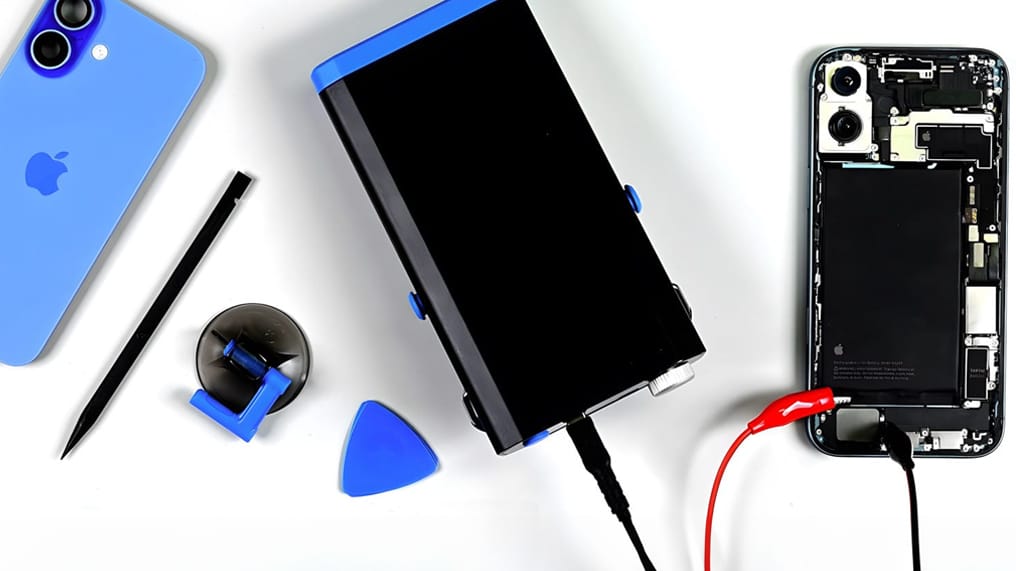
As Apple continues to introduce more advanced hardware, sophisticated cameras, powerful processors, improved displays, new materials, and increasingly integrated internal components, repairing an iPhone is no longer simply a matter of replacing a broken screen or battery.
Modern iPhone repair requires specialized equipment, advanced diagnostics, precision tools, software knowledge, and highly trained technicians.
From component-level motherboard repair and micro-soldering to laser technology, intelligent diagnostics, device programming, and improved repair workflows, the industry is moving toward a more technical and precise approach.
For iPhone owners, this evolution means that many problems that once required expensive part replacement can increasingly be diagnosed and repaired at a much deeper level.
For professional technicians, however, it means continuous learning and investment in better equipment are becoming essential.
Here are 10 major trends shaping the future of iPhone repair.
Accurate diagnosis is the foundation of every successful repair.
Modern iPhones contain hundreds of interconnected components and multiple power, communication, charging, display, camera, and data circuits. A fault in one area can sometimes produce symptoms that appear to originate from another component.
This is why advanced diagnostic equipment is becoming increasingly important.
Modern repair workflows can involve:
Intelligent diagnostic systems can help technicians identify abnormal behaviour faster and narrow down potential causes before replacing components.
The biggest advantage is simple: better diagnosis means fewer unnecessary part replacements.
Instead of automatically replacing an entire assembly, a skilled technician can investigate the actual cause of the failure.
For customers, this can mean lower repair costs, faster turnaround times, and a better chance of preserving the original components of the device.
One of the most important developments in modern iPhone repair is the growth of micro-soldering and component-level motherboard repair.
Traditional repair often focuses on replacing complete modules. But not every fault requires an entire component assembly to be replaced.
A damaged iPhone motherboard may contain a failed capacitor, resistor, filter, IC, connector, trace, or pad while the rest of the board remains perfectly functional.
Micro-soldering allows a trained technician to work directly on these tiny components.
Depending on the specific fault, component-level repair can be used to investigate problems involving:
This requires much more than a soldering iron.
Professional board repair can involve a microscope, hot-air rework station, preheater, DC power supply, thermal camera, precision soldering equipment, specialised programmers, schematics or boardview software, and appropriate testing instruments.
As iPhones become increasingly compact, the ability to perform precise component-level repairs will remain an important part of professional repair.
Back glass damage has become another important area of innovation.
Modern iPhones use sophisticated rear housings containing glass, wireless charging components, cameras, magnets, adhesives, and other sensitive parts.
Removing damaged back glass manually can be extremely time-consuming and carries a risk of damaging surrounding components if performed incorrectly.
Laser technology has introduced a more controlled approach.
Specialised laser machines can be used to assist with the removal of damaged rear glass and adhesive material while helping technicians work more precisely around the internal structure of the device.
The benefits can include:
However, laser equipment is not a substitute for technician skill.
Proper operation requires knowledge of laser settings, device construction, safety procedures, and the components located beneath the damaged area.
The quality of a replacement component can have a significant impact on the final repair.
The market contains different grades and sources of replacement parts, and they are not necessarily identical in quality, performance, durability, or compatibility.
Professional repair shops increasingly need to distinguish between:
These are components designed to meet the specifications of the original hardware or sourced through appropriate supply channels.
These are third-party components manufactured to work with a particular device. Quality can vary significantly between manufacturers and suppliers.
These may reduce the initial repair cost but can sometimes result in differences in performance, durability, colour accuracy, touch response, battery performance, or overall reliability.
A professional technician should therefore consider more than price when selecting a replacement part.
Customers should also be informed about what type of component is being installed and what differences they should expect.
Transparency is becoming just as important as technical ability.
Electronic waste is a growing global issue, and the repair industry has an important role to play in extending the useful life of electronic devices.
Repairing a device instead of immediately replacing it can help keep functional electronics in use for longer.
Board-level repair is particularly relevant because it can sometimes allow a device with a damaged motherboard to return to service without replacing the entire device.
Repair and refurbishment can contribute to:
For many customers, repairing an existing iPhone can make more practical and economic sense than immediately purchasing another device.
The future of the repair industry will therefore involve not only technology but also responsible and sustainable repair practices.
Modern iPhone repair requires continuous education.
A technician who learned basic screen and battery replacement several years ago may now need completely different skills to handle advanced motherboard faults.
Professional technicians increasingly need knowledge of:
Training is particularly important because modern boards contain extremely small components where a minor mistake can cause additional damage.
The best repair environment combines technical knowledge, appropriate equipment, controlled procedures, and practical experience.
Convenience is becoming an increasingly important part of the repair experience.
Some software-related problems can be investigated without opening the device.
Depending on the issue, technicians may assist customers with:
For hardware faults, physical inspection will normally still be necessary.
However, the combination of online communication, appointment systems, digital repair tracking, and remote customer support can make the overall repair process much easier.
Customers increasingly want to know:
Has my device been diagnosed?
What is wrong with it?
How much will the repair cost?
When will it be ready?
Technology is making it easier for professional repair businesses to answer these questions quickly.
Every new iPhone generation introduces new engineering challenges.
As newer models become more sophisticated, technicians must understand the differences between generations rather than assuming that one repair method works for every iPhone.
Areas requiring specialised attention include:
Modern iPhones contain increasingly sophisticated camera hardware. Problems may involve the camera module, communication lines, power supply, connectors, or associated motherboard circuitry.
Advanced displays require careful handling during removal and installation. Damage to connectors, flex cables, sensors, or surrounding components can create additional faults.
Battery replacement requires more than physically installing a new battery. Technicians must consider battery condition, power management, device behaviour, and post-repair testing.
Charging problems can originate from the charging port, cable, connector, charging circuit, USB-related circuitry, power-management components, or motherboard-level faults.
Biometric hardware is particularly sensitive and requires careful diagnosis and repair procedures.
As device architecture evolves, repair technicians must evolve with it.
Professional repair shops are increasingly combining traditional electronics skills with digital technology.
Technicians can now use specialis

A new location, same trusted expertise! Join us on 29th September 2026 as Unique Repair Services officially reopens at Shop B27, Patchyke Plaza, opposite Emeka Offor Plaza, Onitsha Main Market. Visit us for professional iPhone repairs, advanced motherboard Repair