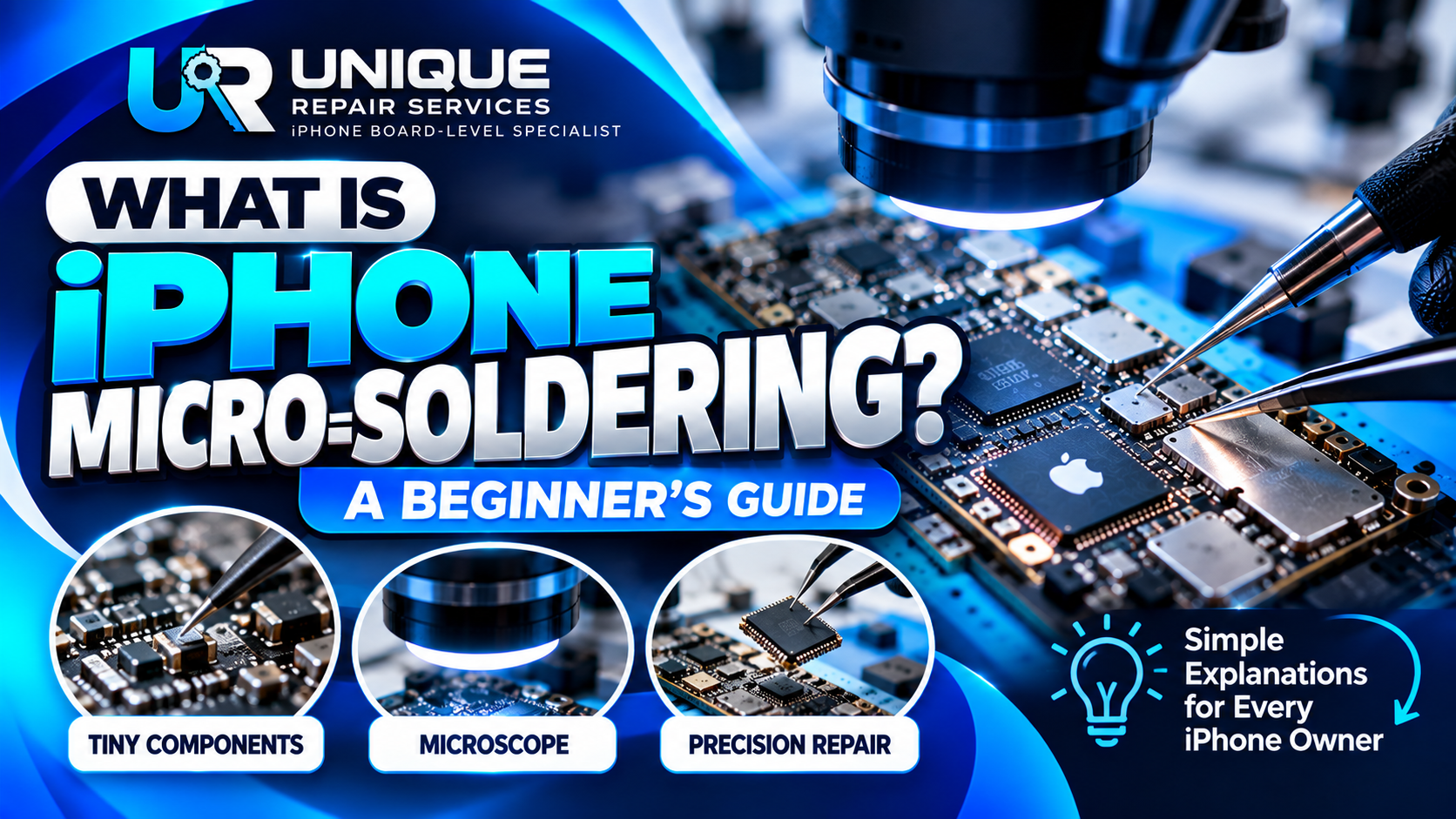
Have you ever wondered what happens when an iPhone has a problem inside the motherboard?
Sometimes, changing the screen, battery or charging port is not enough to fix the problem.
This is where micro-soldering can become important.
If you have never heard of micro-soldering before, don't worry. In this article, we will explain it in simple terms and show you why it is an important part of professional iPhone repair.
Micro-soldering is a type of repair that involves working on the very small components and connections found on a phone's motherboard.
The components on an iPhone motherboard are extremely small. Some are too small to see clearly with the naked eye.
A technician uses a microscope, precision soldering tools and other specialised equipment to work on these tiny parts.
In simple words:
Micro-soldering means repairing very small electronic components and connections on a device's motherboard.
Not every iPhone problem requires micro-soldering.
Many common problems can be fixed by replacing a damaged part.
For example, a broken screen may need a screen replacement.
A worn-out battery may need a new battery.
But sometimes the problem is deeper.
A fault may be located on the motherboard.
For example, an iPhone may:
When the problem is found on the motherboard, micro-soldering may be part of the repair process.
Think of the motherboard as one of the main control centres of your iPhone.
It contains many tiny components that work together to make different parts of the phone function.
These components help control things such as power, charging, communication and many other functions.
Because there are so many small parts on the motherboard, repairing it requires care and precision.
This is why motherboard repair is different from simply changing a screen or battery.
The exact process depends on the problem.
First, the technician needs to find the fault.
This is called diagnosis.
The technician may use a microscope and other testing equipment to inspect the motherboard.
Once the problem has been identified, the technician can decide what needs to be repaired.
The work may involve:
The technician must work carefully because the parts are very small and the motherboard can easily be damaged by incorrect handling.
You cannot properly work on many iPhone motherboard components with your eyes alone.
A microscope gives the technician a much clearer view of the board.
Under the microscope, the technician can see small components, solder joints and connections.
This allows the technician to work with much greater precision.
That is why you will often see a professional board-level technician working under a microscope.
The basic idea is similar, but the work is much more precise.
Normal soldering may involve larger wires or components.
Micro-soldering involves extremely small components and connections.
The technician needs to control the amount of heat, solder and pressure being used.
Too much heat or incorrect handling can damage the motherboard.
This is why micro-soldering requires proper training, practice and suitable equipment.
No.
This is very important.
Micro-soldering is not a solution for every iPhone problem.
Some faults may be caused by the battery, screen, charging port, software or another component that does not require motherboard repair.
A technician should first diagnose the phone before deciding whether micro-soldering is needed.
Diagnosis comes before repair.
When an iPhone has a motherboard problem, ordinary part replacement may not be enough.
A technician with board-level and micro-soldering skills can investigate problems that may be located inside the motherboard.
This can sometimes provide a repair option when simply replacing external parts would not solve the problem.
However, every repair is different.
A proper diagnosis is still necessary before deciding what can be repaired.
Professional micro-soldering requires specialised tools.
Some of the equipment may include:
Each tool has a different purpose.
The technician needs to know how to use these tools correctly and safely.
Having the tools is important, but knowing how to use them is just as important.
Micro-soldering is not something that should be rushed.
The components are very small, and the work requires careful attention.
A technician may spend a long time diagnosing a fault before making any repair.
Sometimes, finding the problem takes longer than the actual soldering work.
This is why patience is an important part of professional board repair.
At Unique Repair Services, micro-soldering and board-level repair are an important part of what we do.
Our focus is on understanding the problem before deciding on the repair.
We use specialised equipment to inspect and diagnose iPhone motherboards and carry out repairs that require precision work.
We also believe that learning never stops.
As iPhone technology continues to change, repair techniques and equipment must continue to improve.
That is one of the reasons we created this blog — to help iPhone owners understand their devices and learn more about professional iPhone repair.
Micro-soldering may sound complicated, but the basic idea is simple.
It is the process of working on the tiny components and connections found on a device's motherboard.
When an iPhone develops a motherboard-related problem, micro-soldering may be one of the repair techniques used to address the fault.
But remember:
Not every iPhone problem requires micro-soldering.
The first step should always be proper diagnosis.
If you understand what is wrong with your iPhone, you can make a better decision about the right repair.
iPhone Board-Level Specialist
Onitsha Main Market, Anambra State, Nigeria
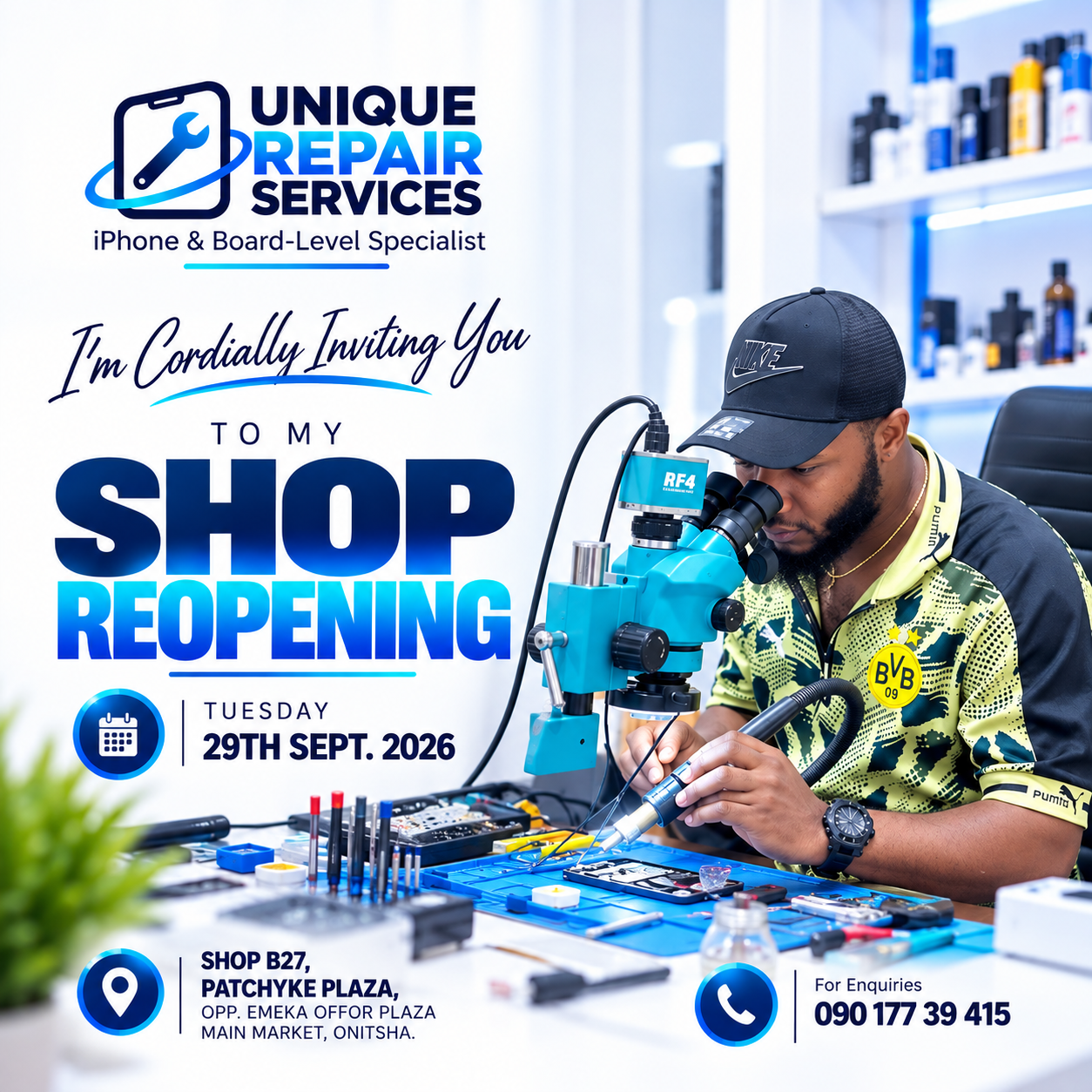
A new location, same trusted expertise! Join us on 29th September 2026 as Unique Repair Services officially reopens at Shop B27, Patchyke Plaza, opposite Emeka Offor Plaza, Onitsha Main Market. Visit us for professional iPhone repairs, advanced motherboard Repair